Supernatural Pregnancy
The Vampire Prince’s BrideSupernatural Pregnancy is the condition in which a human or human-adjacent body carries a child whose biology is shaped by supernatural inheritance, cross-species ancestry, or magical and technological intervention. Across the book, pregnancy can reveal a hidden species identity, expose a long-suppressed genetic history, determine succession, invite coercive scientific experimentation, or become a dangerous test of whether an individual may control their own body. Its decisive significance lies in the way the unborn child becomes both intimate relation and public evidence: a pregnancy can prove what a parent is, threaten an institution’s survival, or place the mother under the authority of rulers, doctors, scientists, and supernatural communities.
Definition and Biological Difference
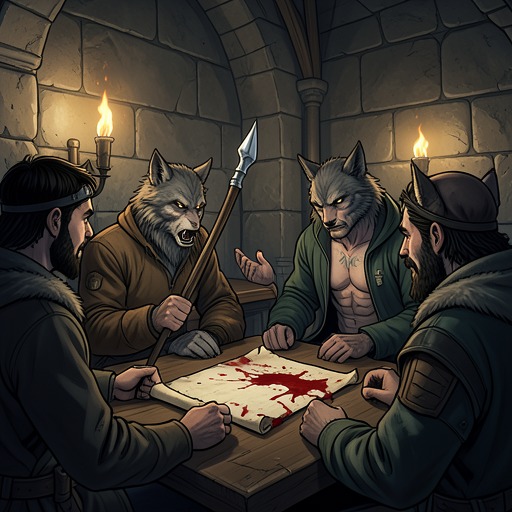
Supernatural Pregnancy does not follow one uniform model. In Claire Doyle’s case, Roland Davis identifies the pregnancy immediately and explains that the child will be a werewolf because lycanthropy is a dominant genetic trait: one werewolf parent is sufficient for the child to inherit it. The pregnancy therefore joins ordinary human gestation to the biological inheritance of a supernatural pack. It also carries a distinctive physical danger. The fetus transforms during every full moon, and that transformation can cause miscarriage before birth. Roland connects this risk to Melissa Clarkson’s repeated miscarriages and explains that very few werewolves are born because pregnancies so often fail at the full moon.
Claire’s pregnancy is medically confirmed rather than left as rumor. After Roland’s disclosure, Grace notes that the medical records are being sent for independent confirmation, while the possibility remains that the earlier miscarriages attributed to Melissa might have been something else. The result eventually comes back positive. Claire’s relief at receiving certainty is complicated by the practical and moral questions that follow: the pregnancy is dangerous, termination would have to occur quickly, and continuing it could expose her to personal danger because Melissa may have been killed for her relationship with Roland. Even so, Claire recognizes that she has a stable job and salary, while the child’s father is a billionaire, and decides that keeping the baby is possible.
The pregnancy continues through increasingly difficult full moons. Roland remains beside Claire even when his body changes into a humanoid wolf, helping her endure the recurring threat of miscarriage. She reaches thirty-six weeks before labor begins, a point at which she is grateful not to face another full moon while still pregnant. The child, Ada, is born safely, and Claire later cares for her as a tiny infant who needs feeding every hour. The successful birth does not erase the danger that defined the pregnancy; it demonstrates that supernatural gestation can survive its own transformation cycle, but only through sustained vigilance and support.
Cross-Species and Shifter Conception
The book broadens the condition beyond werewolf inheritance. Shay explains to Gemma that the Stlozyn descend from humans taken from Earth centuries earlier. Their ancestors were not simply modified; particular genes were made more pronounced, additional DNA strands were added, and those changes enabled shape-shifting. The visible difference between Shay’s scales and Gemma’s human skin therefore conceals a deeper continuity. Their child’s healthy development becomes evidence that humans and Stlozyn are technically the same species, or closely connected subspecies, rather than wholly unrelated forms of life.
That pregnancy also exposes the political value assigned to a hybrid child. The Science Board regards Gemma’s unborn child as impossible and as the key to curing the disease ravaging the Stlozyn population. Niqæsh reprimands Shay because he refuses to take the steps needed to develop the cure, despite having made his research public. The Board’s demand turns the pregnancy into a research resource and treats the fetus as biological material whose value may outweigh the mother’s safety. When Gemma is abducted, the dragoness tells her directly that the child is the key to the cure and describes her as a healthy specimen whose body could sustain prolonged research. The language of specimen, nourishment, and extraction reduces pregnancy to an instrument of collective survival, while Shay’s refusal identifies protection of Gemma and the child as an ethical limit on scientific authority.
The child’s condition is further clarified at birth in Thea’s storyline. After Elise, affected by a potion, attacks Thea and fears that she has harmed her own niece or nephew, Thea reassures her that the potion made Elise act out of character. The child is born a girl with purple scales on her arms, legs, and stomach. Those signs make her shifter identity visible from the beginning, even though the scales will fade and she will appear human for several years. Later, in toddlerhood, she will begin to understand her other nature, grow curious about it, and start to shift. The birth thus presents supernatural identity as both concealed and revealed: the infant can pass as human, yet the body already carries an inheritance that will eventually demand recognition.
Technology, Diagnosis, and the Unstable Body
Supernatural Pregnancy exists alongside advanced bodily technology rather than outside it. Sara wakes after an abduction from Earth hundreds of thousands of years earlier with bionic eyes and military training still central to her identity. Her artificial eyes can even function as concealed stun grenades: she removes one during an escape, uses it to incapacitate pursuers, and then continues the operation with one eyelid covering the empty socket. Her body is therefore neither simply organic nor simply repaired; its technological adaptations are part of her survival and agency.
Lisa’s pregnancy begins with uncertainty over whether the life inside her is a child or a parasite. Zon’s medical equipment detects a lifeform attached to the uterine wall and feeding from Lisa while altering her hormone production. A more comprehensive scan replaces the initial fear with another form of estrangement. Nodules pressed against her abdomen construct a three-dimensional holographic image, and the doctor identifies an embryo whose appearance resembles a mixture of a tadpole and a dinosaur rather than a human baby. Lisa nevertheless recognizes it as an embryo and understands that it will develop into a child.
This diagnostic sequence makes technology a mediator of reproductive knowledge. The scan does not merely confirm a familiar pregnancy; it translates an alien body into visual data and forces Lisa to decide whether an unfamiliar morphology signifies danger or kinship. Zon’s first interpretation is that of parasitism, while the deeper scan supports pregnancy. The distinction is not trivial: one diagnosis implies infestation and removal, the other implies attachment, development, and responsibility. The scene makes the pregnant body a contested interpretive space in which instruments, expertise, and the pregnant person’s own recognition all matter.
Reproduction as Political Power
Pregnancy can also be imposed by political and religious systems. In the succession crisis involving Cheryl, Priest Quincy declares that she and the two Kings Presumptive, Bjorn of the House of Leshire and Maskin, must remain at the Shrine of Nethja until the alignment of the four moons. If Cheryl becomes pregnant, the father will become king; if she does not, both contenders will be executed and a new king chosen. Her reproductive capacity is therefore converted into a succession mechanism, while the shrine becomes a controlled space in which rival men are expected to impregnate her.
Cheryl’s refusal to name a king does not free her from the decision. She says that the Gods must choose and that she is only the queen, but Quincy turns that statement into the legal and ritual basis for the fertility trial. The result is a form of reproductive sovereignty exercised over her: the institution claims to defer to divine choice while determining where she will go, how long she will remain there, and what consequences will follow from her body’s condition. Supernatural Pregnancy thus appears not only as a biological event but as a political verdict capable of producing a king or authorizing executions.
The same logic of exception appears in the Fifth Cycle Festival, an ancient tradition in which a woman is chosen to embody the Goddess and men compete until one remains. The victor becomes the God and receives authority over her; the supposed Goddess was often killed and eaten, which led the United Species to ban the festival. Sara understands the danger because she is a rare and valuable human disguised as an Aphrosian, and a deep scan could expose her DNA. Her body is simultaneously a potential reproductive object, a commodity vulnerable to slavery, and a military identity she must defend. The festival and the succession trial differ in ritual form, but both make a woman’s body the arena through which male authority, divine legitimacy, and social order are produced.
Agency, Ethics, and Consequences
The book repeatedly contrasts pregnancies that are chosen, endured, interpreted, or seized by others. Claire is given frightening information about the full-moon risk and must decide whether to continue. Thea’s pregnancy survives a potion attack because the attack was not an expression of Elise’s ordinary will, and the adults respond by searching secret forums and using a protective potion supplied by Logan’s parents. In both cases, knowledge and support do not remove risk, but they allow the pregnant characters to remain participants in decisions affecting their bodies and children.
By contrast, Gemma’s pregnancy demonstrates what happens when institutions treat reproductive life as a cure rather than a relationship. The Science Board’s scientific transparency principle becomes coercive when it is used to justify taking genetic material from a developing child. Shay’s opposition rests on informed ethical judgment: research may be public, but public knowledge does not grant unlimited access to another person’s body or fetus. The conflict therefore exposes the difference between sharing information and possessing bodies.
Supernatural Pregnancy also produces lasting changes in identity and social belonging. A werewolf child links Claire to Roland and the pack while making full-moon schedules part of ordinary family life. Thea’s daughter will initially pass as human, then encounter curiosity and transformation as she grows. Lisa’s embryo forces her to reinterpret an alien body as a future child. Gemma’s pregnancy challenges the Stlozyn definition of species and threatens to become the foundation of a medical breakthrough. Across these cases, pregnancy is never merely a reproductive condition. It is a threshold through which bodies become evidence, families become political units, and children become bridges—or battlegrounds—between species.